Fireplace installation in Lodi CA - heat that stays in the room, not up the chimney
Your open fireplace looks great, but the room stays cold. We fit an insert that suits your fireplace and actually warms the house.
- Fully licensed and insured.
- Free in-person estimates.
- Expect a reply within 1 business day.
What does it take to put an insert in your Lodi fireplace?
The short answer: Fireplace installation in Lodi usually means fitting an insert, a closed unit that sits inside the firebox of your existing masonry or metal fireplace and works much like a wood stove, so the fireplace you already have starts heating the room instead of just looking nice.
I'm the owner of J&M Lodi Concrete and Masonry, and we're based in Lodi and work across the cities around it, from Sacramento County down toward Manteca and Tracy. Most fireplace calls come from people who love the look of their hearth and almost never light it, because it's drafty, smoky or just doesn't do much. The price moves with what you already have, masonry or factory built, whether you want wood or gas, how far a gas vent has to run and what the chimney looks like once I get a light up it. The schedule mostly turns on getting the right unit in hand and on whether the chimney needs repair before anything goes in, and you'll get your own figure from the estimate.
How do you know your fireplace is ready for an insert?
The room stays cold
You light a fire, sit right in front of it and still reach for a blanket. That usually means most of the heat is heading up the chimney, and every winter you wait, your furnace keeps doing the work the fireplace should be helping with.
Cold air off the hearth
On a still night you can feel a draft coming down the chimney even with no fire going. That's warm house air trading places with outside air through the open firebox, and it keeps happening every day the opening sits there.
Smoke stains on the brick
Dark marks above the opening or a smoky smell after a fire usually mean the fireplace isn't drawing the way it should. Left alone, the soot works deeper into the brick and gets harder to clean, so I'd want to look at the chimney before anything new goes in.
How we handle fireplace installation
The first thing I figure out is whether you have a masonry fireplace or a factory built one, because that decides which inserts will even fit, and there's no sense falling for a unit that can't go in. With a masonry chimney, I look up the flue and check the liner, the lining that carries smoke up and out, since an insert only works right when that liner is installed correctly. If you're leaning toward gas, we talk through how each unit vents before you pick, because the vent decides where pipe runs and what we'd have to open up. Then our crew sets the insert, connects the venting, finishes the trim around the opening and cleans up so your hearth looks like a hearth again and not a job site.
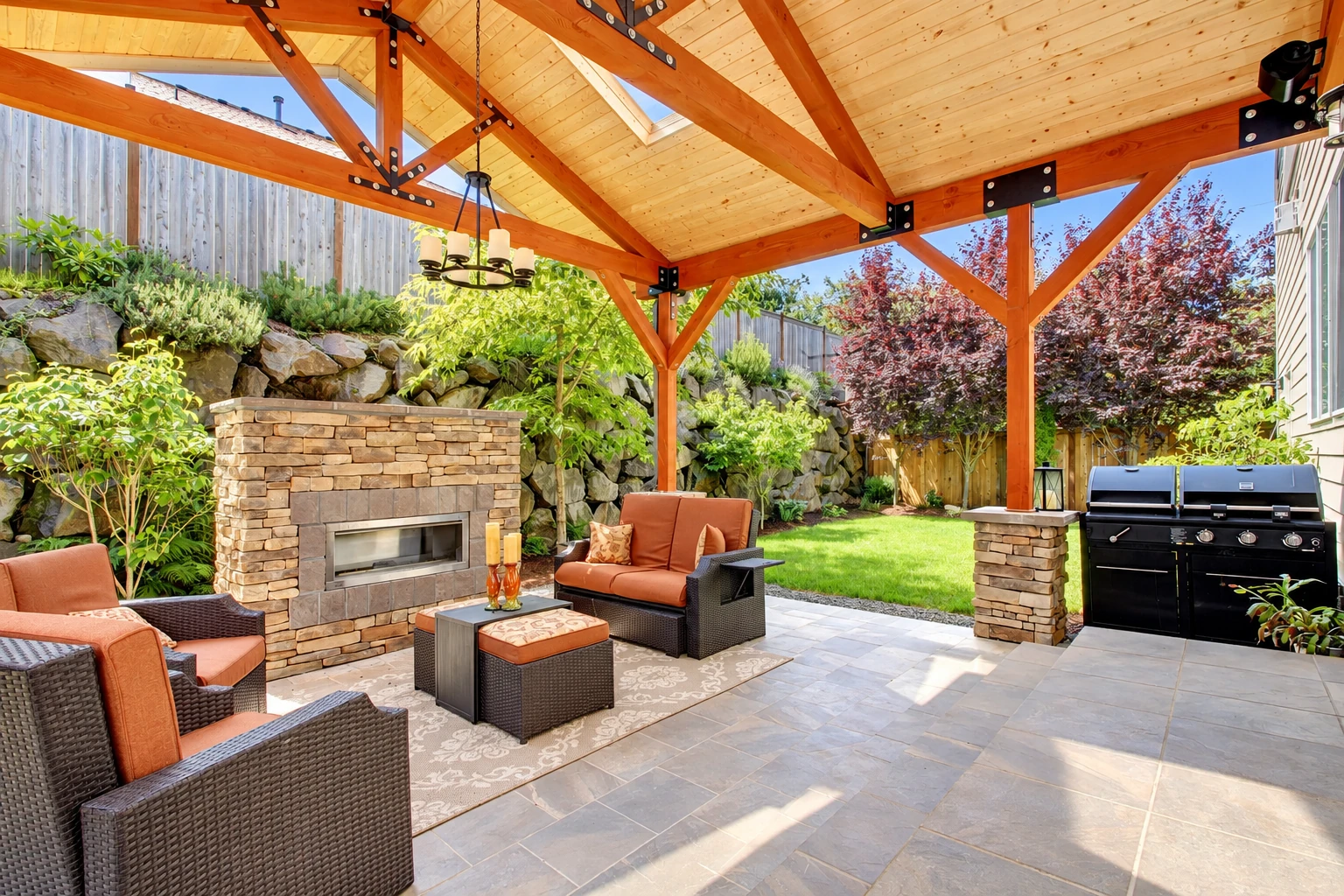
Sometimes the insert fixes the heat and the tired face around it is what still bugs you, and that's where stone veneer installation comes in, a thin layer of stone set right over the old surround. If you'd rather build a new masonry fireplace from the ground up, often out on a patio, the core usually goes up in block the same way we build concrete block walls, and then it gets a finish of brick, stone or stucco.
Wood-burning insert
This suits you if you like the crackle of a real fire but want the heat to stay in the room. It sits inside your existing firebox and burns more like a stove than an open fire, so it fits best when the chimney is sound and you don't mind hauling wood.
Direct-vent gas insert
This suits you if you want heat at the flip of a switch and no ash to sweep. One pipe sends the exhaust outside while a second pulls outside air into the firebox to be heated and pushed into the room, and the vent can run out through a side wall or up through the roof.
What happens after you call us about a fireplace in Lodi?
Here's how a fireplace job goes with us, from the first call to the walkthrough. I'm there for the look and for the work, so you're not explaining your fireplace to three different people.
- Step 01
Call or send a message
Tell us what you have and what you'd like it to do, and if you know whether it's masonry or factory built, mention it. A phone photo of the inside of the firebox helps me know what to look for when I visit.
- Step 02
I look at your fireplace
I come out, check the firebox, the chimney and where a vent could run, and tell you what I see in plain words. You get an estimate showing which units fit, what the work involves and the price, so you can decide without guessing.
- Step 03
We install and walk it
If you go ahead, our crew sets the insert and the venting with me working alongside, then cleans up. We finish by walking the job with you and showing you how the unit runs.
Fireplace installation in Lodi and the cities nearby
In Lodi, the city's Building Division is the office that guides homeowners and contractors on California building, plumbing and electrical code requirements, and its inspectors check the work. I won't guess at whether your fireplace job needs a permit, and if it does, we apply for it and line up the inspections with whichever city or county office covers your address. If you have a code question of your own, the Building Division takes them at (209) 333-6714 or comdev@lodi.gov.
Around here we mostly see two kinds of fireplaces. Older houses tend to have brick fireplaces with chimneys that want a good look before anything new goes in, while newer neighborhoods usually have factory built units, which narrows what can go inside. We find the same mix on jobs in Stockton and Elk Grove, so every visit starts the same way, with me figuring out what you've got.
Get a free estimate for your fireplace insert
Send the form and we'll get back to you within one business day to set a time. I'll come out, look at your fireplace with you and leave you a free estimate, with no pressure to book.
Why Lodi homeowners call J&M Lodi Concrete and Masonry
The owner sizes up your fireplace
I come out to look at your fireplace myself, and I work alongside our crew when we install it. The person who checked your chimney is the one standing at it on install day, so nothing gets lost between the estimate and the work.
Fully licensed and insured
We're fully licensed and insured. That matters when a crew is working in your living room and up on your roof, so you're not the one left holding the risk.
Trained by old-school masons
I started this business in 2023 after learning from older masons who cared about the details nobody sees, like the liner and the mortar behind the trim. A lot of fireplaces around Lodi sit in older brick, and if yours needs repair before an insert, or doesn't need an insert at all, I'll tell you straight.
On a fireplace, the parts that count are the ones you won't see once the trim goes on, the liner and the vent, so that's where I spend my time. Reach us through our contact page and let me know whether your fireplace is masonry or factory built, if you know.
Fireplace insert questions from Lodi homeowners
Can any fireplace insert go in my fireplace?
No, the insert has to match the fireplace you have. A factory built fireplace, also called zero-clearance, needs an insert that's specifically designed and tested for that unit, while a masonry fireplace usually leaves you more choices. Knowing which one you have narrows the field before you start shopping.
What causes an open fireplace to barely warm the room?
Most traditional open fireplaces lose over 90 percent of the fire's heat up the chimney, and a good share of your room's heated air goes with it. An insert closes off that open firebox and burns more like a stove, which is why it's the usual fix when you want the fireplace to actually heat the room.
Is a ventless gas fireplace a good choice?
The EPA doesn't support ventless gas units because of indoor air quality concerns, even though some models are built to run with no outside vent. That's why we go over how each gas unit vents with you before you choose one.
How much does it cost to install a gas fireplace insert in Lodi?
Across the US, installing a gas fireplace insert usually costs about $2,300 to $8,000 per job, materials and professional labor included. That's a national figure, not our quote, and your own price comes from the on-site estimate, where I can see the firebox, the chimney and how far the vent has to run.
How often should a fireplace insert be inspected?
At least once a year, with cleaning and repairs as needed, under the national safety standard the chimney trade follows, and the EPA gives the same yearly advice for gas stoves. That check looks at whether everything is sound, how much buildup there is and whether the clearances, the safe space between the unit and anything that can burn, are still right.
How do I tell if my fireplace is masonry or factory built?
A masonry fireplace usually has a firebox lined with brick or stone and a masonry chimney above it, while a factory built one usually has a metal firebox, often with panels molded to look like brick, and a metal flue pipe. If you can't tell, send a photo of the inside of the firebox when you call, or I'll sort it out when I come by.
Masonry work that goes with a new fireplace
Stone veneer installation
Refacing the wall around your fireplace with stone gives the room a fresh look and covers stained or dated brick without tearing the old surround down.
Concrete block walls
Block is the backbone of many outdoor fireplaces and garden walls, so if you're planning a patio fire feature, a solid block core comes first.
Call us about your fireplace insert
Call (209) 269-8703 or use our contact form, and send a photo of your firebox along so I know what to bring when I come out.